Person in a dark jacket and jeans pushing a red snow shovel across a snow-covered paved driveway in front of a metal gate
Winter on Long Island

Lower Back Pain After Shoveling Snow on Long Island

The first real snow of the winter comes, everyone on the block grabs a shovel, and by the afternoon half of them can't stand up straight. Here's how to shovel without hurting your back, and what to do if you already have.

By Dr. Abby Dante, DC Last updated

Before the next storm

Get your back ready before the next snowfall

When a storm comes through, the driveway, the walk and the car all have to be dug out, usually before work or school. Read the technique sheet below before the next one. Already hurting? Call or text 631-212-2996 and we'll find you a time in Islandia or Quogue.

The short answer

Why does shoveling snow hurt your lower back?

Shoveling is a strength workout most of us don't train for: bend, scoop, lift, twist and throw, over and over, in the cold. The lower back takes most of it.

A study of U.S. emergency departments from 1990 to 2006 estimated that 195,100 people were treated for snow shovel-related injuries and medical emergencies over those 17 years, an average of 11,500 a year. Injuries to the lower back made up 34.3% of cases, and the most common cause was acute musculoskeletal exertion (53.9%), followed by slips and falls (20.0%). Most of these incidents (95.6%) happened in and around the home (Watson et al., American Journal of Emergency Medicine).

Shoveling is hard on the heart, too

In the same study, cardiac-related visits were 6.7% of cases, and they included all 1,647 deaths recorded. The American Heart Association says people with heart disease or its risk factors, and anyone who has had bypass surgery or coronary angioplasty, should have someone else clear the snow (American Heart Association). If you have a heart condition, ask your doctor before you shovel at all. Stop right away if you feel chest pain or pressure, lightheadedness or heart palpitations, and call 911 if they don't ease shortly after you stop.

The good news: most back pain after shoveling is a strain that settles with time and gentle movement (NHS). Our lower back pain guide explains how we treat it.

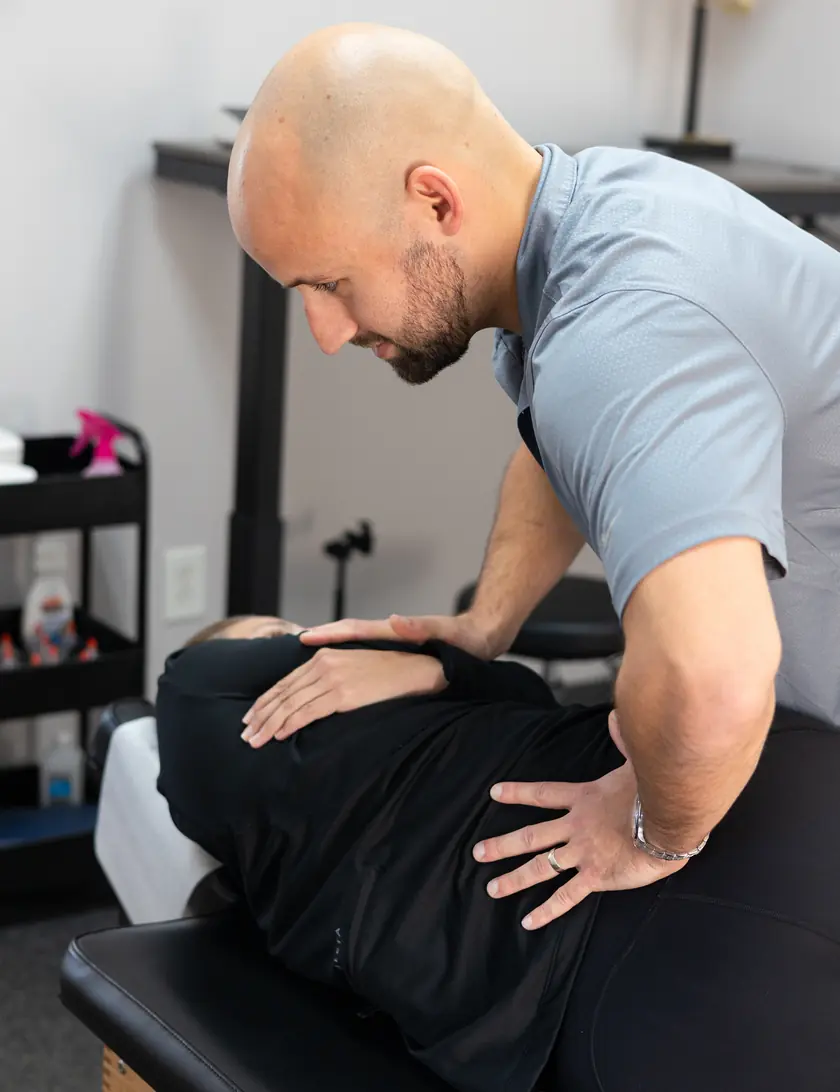
Dr. Dave Atlas working on a patient's lower back on the treatment table
Technique sheet

How to shovel snow without hurting your back

Six steps, in order, based on the American Academy of Orthopaedic Surgeons' snow-clearing advice (AAOS OrthoInfo). Print it, or keep it on your phone by the door.

1.Warm up first

10 minutes
  1. March in place or walk around the house.
  2. Add a few easy hip circles and arm swings.
  3. Go out warm, not straight from bed.

Cold, stiff muscles are the ones that strain. AAOS suggests 10 minutes of light exercise before you start.

2.Use the right shovel

Before you start
  1. Pick one that's comfortable for your height and strength, not too heavy or too long.
  2. Space your hands apart on the handle for leverage.

A shovel that fits keeps you more upright, so your legs do more of the work.

3.Push, don't lift

Whenever you can
  1. Push the snow to the side of the driveway like a plow.
  2. Only lift what you can't push.

Pushing takes a little less effort than lifting and throwing, which is easier on the back and the heart.

4.Small scoops, lift with your legs

Every scoop
  1. Feet apart, knees bent, back straight: squat down to the shovel, don't bend at the waist.
  2. Take small amounts, and keep the load close to your body, not at arm's length.
  3. Clear deep or heavy, wet snow in layers, never all at once.

A full shovel held out in front of you puts a lot of weight through the spine.

5.Walk it, don't twist it

Every scoop
  1. Turn your feet and walk to where you're dumping the snow.
  2. Never throw it over your shoulder or to the side.

AAOS warns that the twisting motion strains your back, so keep your feet and shoulders facing the same way.

6.Break it up

Every few minutes
  1. Stop often, stand up tall and walk around.
  2. Drink water.
  3. Clear early, before the snow packs down.

Short breaks keep your technique from falling apart halfway down the driveway.

General technique, not a treatment plan. If you have a heart condition or high blood pressure, or you don't usually exercise, ask your doctor before you shovel. Stop if you feel chest pain or pressure, dizziness or shortness of breath.

Red snow shovel with a wooden handle pushing through fresh snow on paving stones
Check your symptoms

Hurt your back shoveling: chiropractor, doctor or ER?

Most back pain after shoveling is a strain. Some of it isn't, and these are the signs that send you to a physician or the ER before you see us (NHS: back pain).

Book a visit

Sore, stiff lower back that eases when you move

The typical shoveling strain. Keep moving gently and use the first-48-hours plan below. If it isn't easing after a couple of days, book a visit.

Book a visit

Sciatica flare-up after shoveling

Pain running from the back into the buttock or down one leg, maybe with some tingling. Often manageable with the right movement and exercise; see our sciatica page. If the leg is getting weaker, see a physician first.

ER or 911 now

Chest pain, pressure, lightheadedness or palpitations

Stop shoveling now. If it doesn't ease shortly after you stop, call 911. This is a heart warning, not a back problem.

ER or 911 now

Numbness around the groin, or bladder or bowel changes

Numbness around the genitals or anus (the saddle area), trouble peeing, or loss of bladder or bowel control, or tingling, numbness or weakness in both legs. Go to the ER now.

See a physician first

You slipped on ice and landed hard

Back pain after a hard fall needs a medical check first, especially if you can't bear weight or see swelling or a change in the shape of your back.

See a physician first

Fever, feeling unwell, or pain that's worse at night

Back pain with a fever or chills, pain that doesn't ease with rest or is worse at night, or unexplained weight loss needs a physician.

The first 48 hours

What should I do after hurting my back shoveling snow?

A general guide for an ordinary strain, not a schedule. If anything from the red-flag list shows up, stop and get it checked.

  1. Right away

    Stop, stand up, check in

    Put the shovel down. Walk inside slowly. Run through the warning signs above. Leave the rest of the driveway for someone else, or for later.

  2. The first day

    Keep moving gently

    Short walks around the house, changing position often, and lying down only when you need a break. Find the positions that ease it. Long spells in bed tend to slow things down (NHS).

  3. Day two

    Add easy movement and heat

    Longer walks if they feel fine. Superficial heat is one of the first-line options a major medical guideline lists for recent low back pain (American College of Physicians). Skip the next round of shoveling.

  4. After 48 hours

    Not easing? Get it looked at

    If it's no better, getting worse, or keeps catching you, book a visit. We start with a movement assessment, treat with hands-on care, and send you home with a few exercises so you're ready for the next storm. Wondering about a scan first? Read do I need an MRI for back pain?

Questions

Snow shoveling back pain: your questions

Should I stay in bed after hurting my back shoveling?

Usually not. Rest the activity that hurt you, but keep moving gently: short walks around the house and changing position often tend to help more than lying still. If the pain is severe, keeps getting worse, or comes with any of the warning signs on this page, get it checked by a medical doctor.

What if the pain goes down my leg after shoveling?

Pain that runs from the lower back into the buttock and down the leg, sometimes past the knee, is often called sciatica. Sciatica can flare up after shoveling, and it often settles with the same approach: gentle movement, avoiding the positions that make it worse, and a few targeted exercises. Read our sciatica page for more.

Go to the ER if you have numbness around the groin or buttocks, new trouble controlling your bladder or bowels, or weakness or numbness in both legs.

Is there a chiropractor near me for back pain after shoveling?

Yes, on both sides of the Island. Our Islandia office on Veterans Memorial Highway is next door to Hauppauge and a short drive from Smithtown, Commack, Central Islip and Ronkonkoma. Out east, Dr. Abby sees patients at the Quogue office, inside Studio 7 Pilates, for patients from Westhampton Beach to Hampton Bays. Call or text 631-212-2996 to book either one.

Book a visit

Back sore from the driveway?

One-on-one visits of 30 to 60 minutes in Islandia or Quogue. Every plan includes exercise-based rehab and a home program.

Islandia

1777 Veterans Memorial Highway Suite 22, Islandia NY 11749. Mon–Fri 8:00am–8:00pm, Sat 7:00am–1:00pm. Dr. Abby and Dr. Dave.

Quogue

164 Jessup Ave, Quogue NY 11959. Inside Studio 7 Pilates, with Dr. Abby.

New patients can apply for a free Discovery Visit: apply online (opens in a new tab).

Photo credits: stock scenes by kaboompics (Pexels, 2 photos). Stock photos show models, not our doctors, patients or offices. All credits.