Running injuries

Why does my hip hurt after running?

Hip pain in runners comes from a handful of places, and where you feel it is the best clue: the front of the hip, the side, the back, or deep in the groin.

By Dr. Abby Dante, DC Last updated

Side-view silhouette of a runner in full stride against a dark background, with sunlight on the track at his feet
The short answer

Why do runners get hip pain?

Every stride lands you on one leg, and the hip muscles have to hold your pelvis level and drive you forward each time. When the load goes up faster than those muscles and tendons can adapt (a new plan, more miles, hills, a race build-up), the hip is often where it shows.

Most hip pain from running is that kind of overload, and it responds to the same things: easing the load for a while, building strength, and returning gradually. A smaller group of hip pain isn't a muscle or tendon problem at all. It comes from the lower back, or, less often, from the bone itself, and those need a different plan. The table below sorts them by where it hurts.

Running pain lower down has its own pages: knee pain after running, outside knee pain and the IT band, shin splints and heel pain after running.

Where it hurts

Front, side or back: where does your hip hurt?

Hip pain from running by location: likely cause, what it feels like, and what to do
WhereOftenWhat it feels likeWhat to do
Front of the hipA hip flexor strain or irritated hip flexor tendonPain in the crease at the front of the hip, worse lifting the knee, on hills and in speed workBook a visit. Ease off hills and speed while it settles.
Side of the hipGluteal tendinopathy (greater trochanteric pain)Pain over the bony point at the top of the thigh, sometimes down the outside of the leg; worse lying on that side, on stairs or uphill (Cleveland Clinic)Book a visit. Tendinopathy rarely gets better with rest alone (Cleveland Clinic); exercises are what usually help.
Back of the hipA hamstring tendon or deep gluteal problemPain at the sit bone or deep in the buttock, worse with speed, hills or long sittingBook a visit. Ease off speed and hills while it settles.
Buttock and down the legReferred from the lower backBack stiffness or pain with it, pain that travels down the leg, sometimes tinglingBook a visit. See our lower back pain and sciatica pages.
Deep in the groinPossible stress fracture of the hip (femoral neck)Pain most often at the front of the groin that builds with running and eventually is there at rest and at night (Robertson and Wood, 2017)Stop running and see a physician first. This one needs imaging.

Go to the ER or call 911 for severe hip pain after a fall, a leg you can't put weight on, or tingling or loss of feeling after an injury (NHS). A hot, swollen hip, or hip pain with a fever, needs a doctor the same day.

Reading the signs

Which hip pain from running needs a doctor?

Hip and groin
Running is the sport most often linked to stress fractures of the hip, and the advice when one is suspected is to stop weight-bearing on that hip and get an X-ray urgently (Robertson and Wood, 2017). Groin pain that keeps building is not one to run through.
Lower back
Back pain with leg pain is usually something we can help with. Numbness, a leg going weak, or any change in bladder or bowel control goes to a medical doctor first.

Everything else on this page, the front, side and back of the hip, is the kind of running pain we assess and treat here.

Between visits

What exercises help hip pain from running?

Examples of the hip strength work a runner's home program often includes. Which ones, and how hard, depends on where your hip hurts and what your exam shows.

Glute bridge

3 × 10–12
  1. Lie on your back, knees bent, feet flat and hip-width apart.
  2. Squeeze your glutes and lift your hips until your body is in a line from knees to shoulders.
  3. Pause, then lower slowly.

Strengthens the glutes and hamstrings that drive you forward and steady the pelvis on every stride.

Clamshell

2 × 15 each side
  1. Lie on your side, hips and knees bent, feet together.
  2. Keep your feet touching and lift the top knee.
  3. Lower slowly without rolling your hips back.

Works the muscles on the side of the hip. Lie on the side that doesn't hurt if the outer hip is sore.

Bent-knee side plank

3 × 15–20 sec each side
  1. Lie on your side, propped on your forearm, knees bent behind you.
  2. Lift your hips so your body is straight from knees to shoulders.
  3. Hold, then lower with control.

The glute muscles that keep your pelvis level when you land on one leg, which is all running is.

Step-down

2 × 8 each side
  1. Stand on the bottom stair on one leg, holding the rail.
  2. Slowly lower the other heel toward the floor, keeping your knee over your foot and your pelvis level.
  3. Push back up.

Single-leg control, the way running loads the hip. Start with a low step.

These are examples, not your plan. Every plan includes exercise-based rehab and a home exercise program written for you after an assessment. Stop any exercise that brings on sharp pain, numbness or tingling, and ask us first if you're not sure it suits you.

Woman doing a glute bridge on a mat on the floor of a bright room with large windows
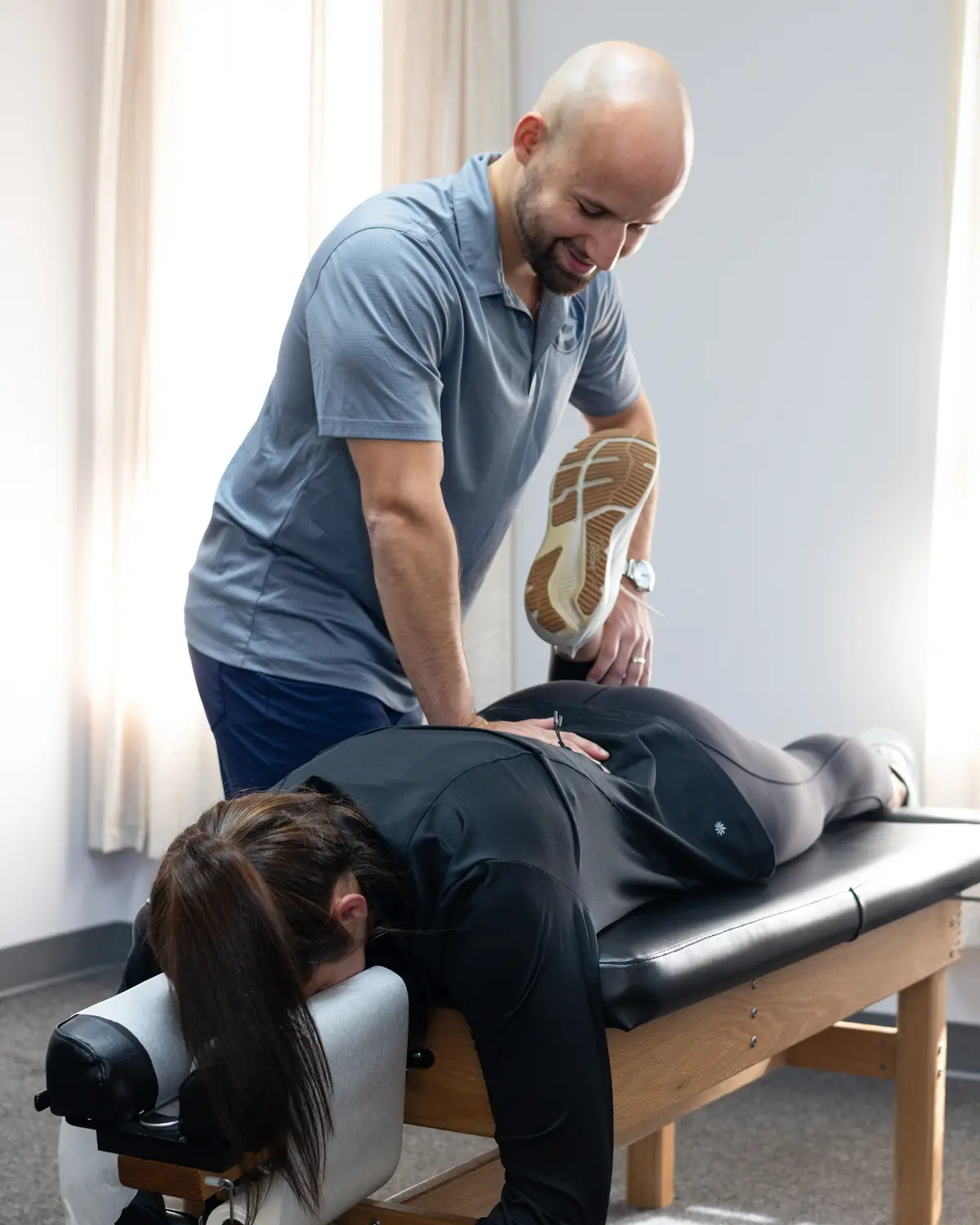
Dr. Dave Atlas bending the knee of a patient in running shoes who is lying face down on a treatment table
Who you'll see

See Dr. Dave in Islandia

Dr. Dave Atlas is a TPI Certified, sports-focused chiropractor dedicated to helping athletes and active individuals move better, perform at their best and stay injury-free. A summa cum laude graduate of the University of Bridgeport School of Chiropractic, he specializes in personalized care, custom rehabilitation plans and detailed, patient-focused treatment.

A visit with Dr. Dave or Dr. Abby is one-on-one and runs 30-60 minutes: a movement assessment first, then hands-on care (soft tissue work, joint mobilizations and chiropractic adjustments, which are always optional; see what manual therapy involves), then the exercises that make up your home program. Both see patients at the Islandia office.

Read Dr. Dave Atlas, DC's full bio

Questions

Hip pain questions from runners

01

Why do my hips hurt from running?

Most often because the muscles and tendons around the hip are taking more load than they're ready for: a jump in mileage, more hills or speed work, a long race build-up, or a lot of running on a cambered road. Where it hurts narrows it down: the front of the hip is usually the hip flexors, the outside the gluteal tendons, the back the hamstring or deep glutes.

Groin pain that has been building, especially if it's now there at rest or at night, is different. See a physician first, because it can be a stress fracture of the hip.

02

Can I keep running with hip pain?

Often, at a level that doesn't make it worse: shorter, flatter, slower runs, or cross-training for a while. Pain that builds as you run, makes you limp, or is there the next day means back off. Outer hip pain from the gluteal tendons rarely gets better with rest alone, so the strength work matters as much as the break. Groin pain that is getting worse is the one to stop running on and get checked. More on staying in training on our chiropractor for runners page.

03

Could my hip pain be coming from my lower back?

Yes. Pain in the buttock or the back of the hip, especially if it runs down the leg or comes with stiffness in the back, can be referred from the lower back. Our lower back pain page and sciatica page explain what to look for. Numbness, weakness, or changes in bladder or bowel control need a medical doctor straight away.

04

Is there help for hip pain from running near Connetquot?

Our office isn't in the Connetquot area. If you run the trails at Connetquot River State Park Preserve in Oakdale, or around Bohemia and Ronkonkoma, we're in Islandia, on Veterans Memorial Highway, open weekdays to 8pm and Saturday mornings, with on-site parking. Call or text 631-212-2996 to book with Dr. Abby or Dr. Dave, or see the Islandia office page.

Book a visit

Book a visit for hip pain in Islandia

Call or text 631-212-2996, or apply for a free Discovery Visit if you're new to us.

Photo credits: stock scenes by Caique Araujo (Pexels) and Vlada Karpovich (Pexels). Stock photos show models, not our doctors, patients or offices. All credits.