Going uphill, the big muscles on the front of your thigh, the quadriceps, shorten as they push you up. Going downhill they do the opposite: they lengthen while they work, braking every step so you don’t fall forward. That braking, called eccentric work, is hard on the quads, and the force runs through the quad tendon, the kneecap and the patellar tendon below it.
The kneecap sits in the middle of that chain, and the more the knee bends under load, the harder it presses into its groove. Downhill you land on a bent knee with a long braking stride, so the front of the knee takes more of the work. In a small lab study of 20 recreational runners on a treadmill, running on a 6° decline produced higher peak stress at the kneecap joint than running on the level or uphill, and the researchers linked it to runners staying more upright on the way down (Ho et al., Physical Therapy in Sport, 2018).
The American Academy of Orthopaedic Surgeons describes patellofemoral pain as a dull ache in the front of the knee that stairs, running and squatting tend to bring on, with weak or imbalanced quadriceps a common factor (AAOS OrthoInfo).
Running, hiking and walking downhill
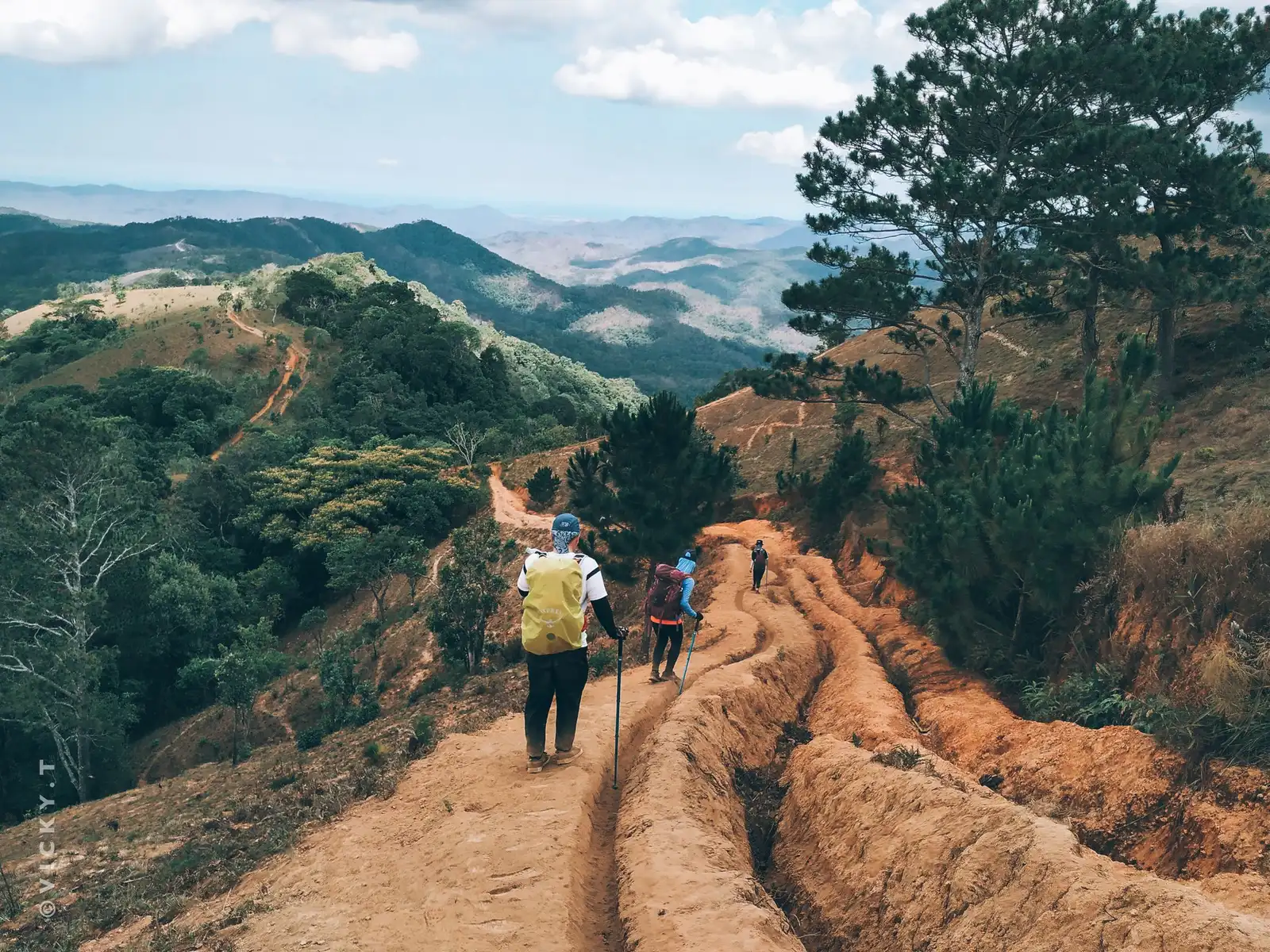
Knee pain running downhill tends to show up on long descents and late-race drops, when your legs are tired. Knee pain hiking downhill is often worse: a pack, big step-downs off rocks, and a descent that can last an hour. Knee pain walking downhill, even on a gentle grade, usually means the knee is sensitive right now, not that something is torn.
Why does my knee hurt going down stairs?
Stairs are the same problem in miniature: each step down is a single-leg, bent-knee brake. Most knee pain going downhill and on stairs is a load problem. The knee is being asked to brake more than it’s ready for, and load problems respond to changing the load and building capacity.
Shins, heel or hip complaining instead? See shin splints, heel pain after running and hip pain from running.