Wall sit
3 × 20–30 sec- Lean your back against a wall, feet a step out in front.
- Slide down only as far as is comfortable.
- Hold, then stand back up.
Loads the quads without impact. Stay higher if the front of the knee complains.


Where it hurts is the best first clue. Here’s how to read your knee after a run, what you can do this week, and when it’s a job for a physician instead of us.
By Dr. Abby Dante, DC Last updated
Find the spot that matches yours. It’s a guide to the likely cause, not a diagnosis.
Usually patellofemoral pain, often called runner’s knee: a dull, aching pain in the front of the knee, brought on by things that repeatedly stress it, like running, stairs and squatting (AAOS OrthoInfo). It often aches after sitting with your knees bent, too.
Hills and stairs make it worse, and our guide to knee pain running downhill explains why in detail.
Aching or sharp pain on the outside of the knee, often worse going downhill, points to IT band syndrome (Cleveland Clinic). It has its own page: why does the side of my knee hurt?
Pain between the kneecap and the shin, often from repetitive running or jumping, is usually tendon pain (NHS): the patellar tendon, which attaches the bottom of the kneecap to the top of the shinbone (AAOS OrthoInfo). Tendons like a slow, steady build.
These point more toward a structural injury than an overuse ache. Catching or locking and the knee giving way are among the symptoms of a meniscus tear (AAOS OrthoInfo), and ligament injuries can feel unstable too. See a physician first; an MRI may be needed.
Get urgent care now. A knee you can’t put weight on, that’s badly swollen or has changed shape, or that’s hot and red with a high temperature needs to be seen the same day (NHS: knee pain).
The pattern is mostly about load, not damage, which is good news: load can be changed. The tricky part is that the knee is often where the problem shows up, not always where it starts.
For the overuse aches on the map above, not the red flags. A guide, not a schedule.
Active humans require active treatment. A first visit starts with how the knee started hurting and what makes it better or worse. Then we watch you move: squats, step-downs, single-leg balance, and a hop if it’s comfortable. We’re looking for what brings the pain on, and screening for anything that should go to a physician instead.
Then hands-on treatment where it helps: soft tissue work, joint mobilizations and chiropractic adjustments, which are always optional (what manual therapy involves). Most of the time in a visit goes to movement and exercise, because the knee you leave with has to hold up on the next run. Care is one-on-one, visits run 30 to 60 minutes, and every plan includes a home exercise program. We won’t promise a number of visits before we’ve examined you.
Both doctors see runners at the Islandia office, next door to Hauppauge. The drive from Hauppauge is a few minutes east.
Dr. Abby also sees patients at our Quogue office, inside Studio 7 Pilates on Jessup Avenue. Call or text 631-212-2996 to book a Quogue time.
Knees rarely hurt alone in a training block. If your shins, heels or hips are joining in, see shin splints, heel pain after running or hip pain from running, and how we work with runners in general.
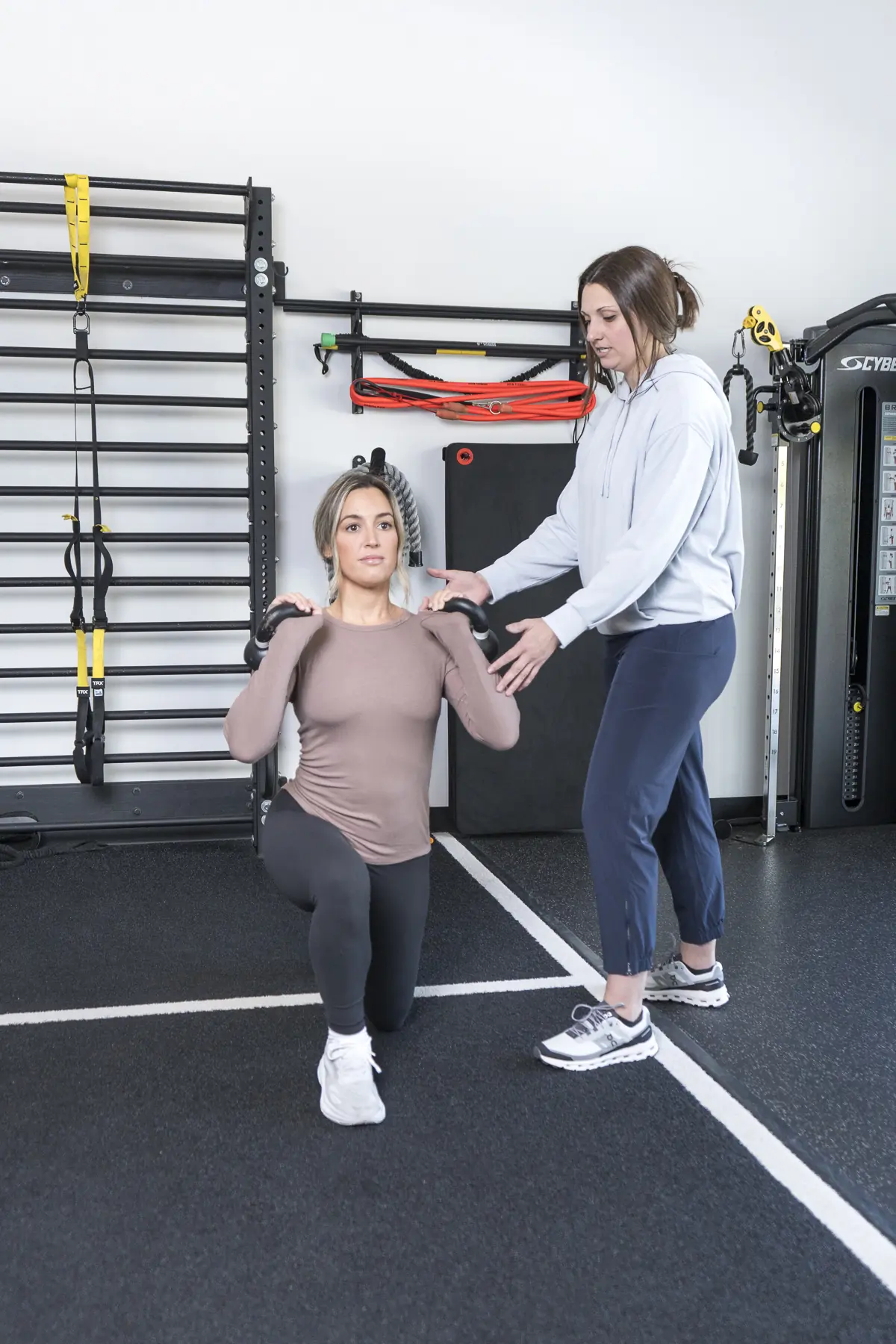
AAOS recommends strengthening and stretching the quadriceps and strengthening the hip muscles for front-of-knee pain. These are common, low-risk examples of that kind of work.
Loads the quads without impact. Stay higher if the front of the knee complains.
Running and stairs both ask the knee to control a bend on one leg. This practices it slowly.
Works the muscles on the side of the hip that help keep the knee from drifting in as you land.
Strong calves take some of the landing load that would otherwise go to the knee.
These are examples, not your plan. Every plan includes exercise-based rehab and a home exercise program written for you after an assessment. Stop any exercise that brings on sharp pain, numbness or tingling, and ask us first if you're not sure it suits you.
It's common with front-of-knee pain. During the run the knee is warm and busy; afterwards it stiffens, especially if you then sit for a while with your knees bent. It's still a sign the knee did more than it was ready for. Pain that builds in the hours after a run and is worse the next morning is a cue to back off the distance, hills or speed for a while.
Often, yes, with changes. A mild ache that settles by the next day usually means cut back, not stop: shorter, flatter, easier runs. Pain that makes you limp, gets worse as you go, or is worse the next day means take a break from running and cross-train instead.
Stop and see a physician if the knee swells, locks, gives way, or you can't put weight on it.
Sometimes it's part of the picture. Weak hip muscles can let the knee drift in as you land. Cleveland Clinic lists weak hip muscles as a risk factor for IT band pain, and hip strengthening is part of the standard advice for runner's knee. That's why the plan often includes hip work even when only the knee hurts. If the hip itself aches, read hip pain from running.
Our office isn't in Hauppauge. It's next door, at 1777 Veterans Memorial Highway in Islandia, about 5 minutes away, open weekdays until 8pm and Saturday mornings. See our Hauppauge page for the drive. On the East End, Dr. Abby sees patients at our Quogue office. Call or text 631-212-2996 to book either one.
Book a movement assessment at the Islandia or Quogue office.
1777 Veterans Memorial Highway Suite 22, Islandia NY 11749. Mon–Fri 8:00am–8:00pm, Sat 7:00am–1:00pm. Dr. Abby and Dr. Dave.
164 Jessup Ave, Quogue NY 11959. Inside Studio 7 Pilates, with Dr. Abby.
New patients can apply for a free Discovery Visit: apply online (opens in a new tab).
Photo credits: stock scenes by Alex Kinkate (Pexels). Stock photos show models, not our doctors, patients or offices. All credits.